
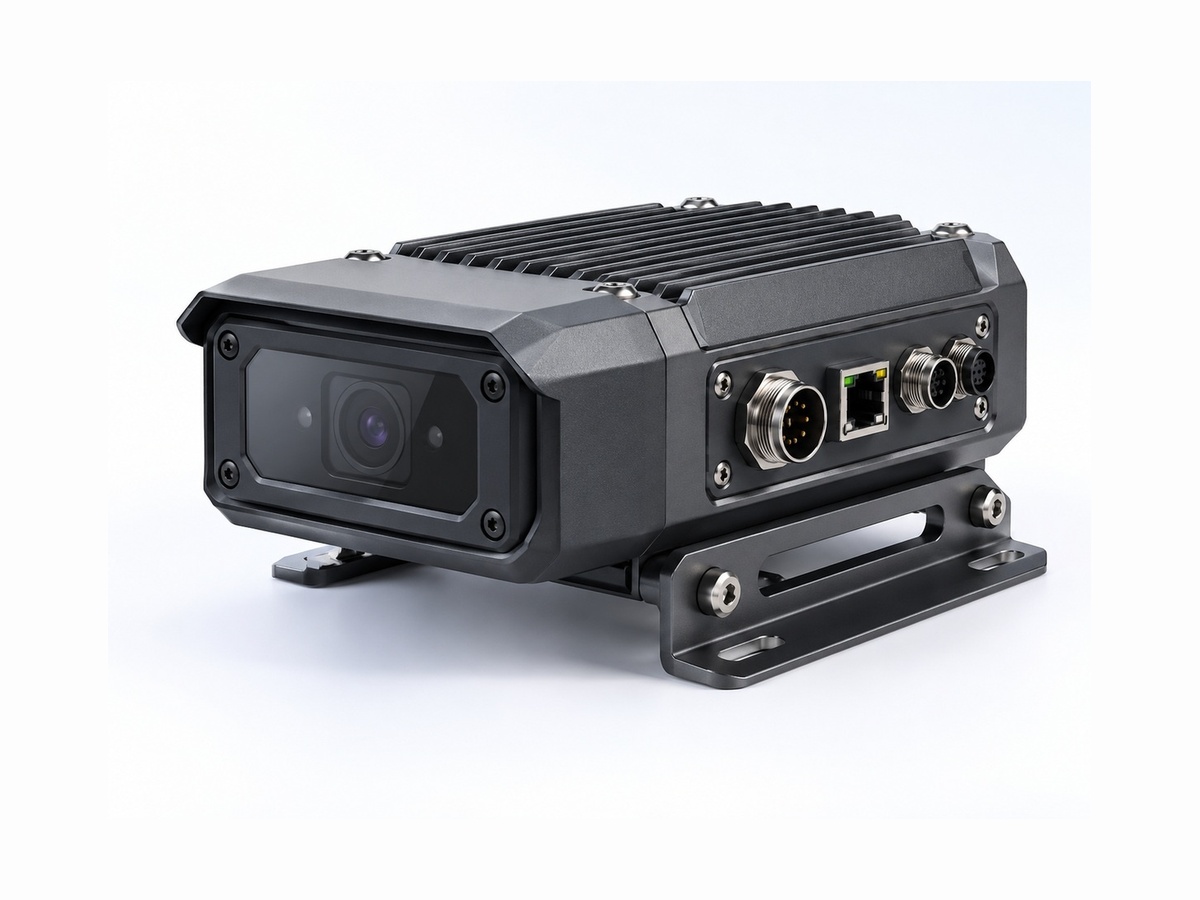

DVS+SNN Safety Module

DVS + SNN SAFETY MODULE

An Assist Module for
Earlier Dynamic-Risk Perception in AMRs

A DVS (Event Camera) detects motion changes as asynchronous events, while an SNN (Spiking Neural Network) analyzes approach direction and temporal dynamics to support AMR risk assessment.

Integrated with the existing AMR controller, the module provides risk information for stop, slow-down, and rerouting decisions, targeting dynamic objects such as people, carts, and loads in logistics and manufacturing environments.

Safety Assist Concept
It is being developed as an intelligent assist module that detects dynamic risks earlier and supports AMR control decisions, rather than replacing existing safety devices such as Safety LiDAR or bumpers.
DVS+SNN Safety Module hardware concept
TECHNOLOGY STACK

DVS × SNN × Neuromorphic Edge Architecture

The architecture combines event-driven input with spike-based inference instead of frame-centric image processing, enabling dynamic-risk assessment close to the field edge.

01 · EVENT VISION

DVS Event Camera

It asynchronously receives events from pixels where brightness changes occur and forms motion-focused input data. This stage rapidly captures changes from dynamic objects such as people and carts.

ROLE · Event Input / Motion Change Detection
02 · NEUROMORPHIC AI

SNN Risk Intelligence

This AI processing stage converts events into spikes and uses temporal change patterns to infer whether an object is approaching, its approach direction, and potentially hazardous approach conditions.


ROLE · Event-to-Spike / SNN Inference
03 · EDGE CONTROL

Edge Safety Module

Event processing, SNN inference, and risk calculation are performed at the edge, with Stop / Slow / Detour decision information delivered to the AMR Controller.

ROLE · Risk Score / AMR Interface
REAL-TIME PIPELINE

From Event Input to AMR Control

DVS events are filtered and approach features are extracted before SNN inference and risk calculation, after which the results are delivered to the AMR controller.

01

Event Input

Asynchronous DVS event input

02

Noise Filter

Background and noise event removal

03

ROI Extraction

Extraction of candidate motion regions

04

Approach Feature

Approach-direction and change analysis

05

SNN Inference

Dynamic-risk class inference

06

Risk Score

TTC, speed, and direction fusion

07

AMR Control

Stop, slow-down, and rerouting integration

RISK INTELLIGENCE

Risk Intelligence from Motion Dynamics

Risk information is generated by considering motion density, approach velocity, directional change, and stopping distance together rather than relying only on object presence.

Dynamic-risk perception of an AMR detecting approaching people and carts
SIGNAL 01

Event Density

Assesses motion activity using the amount of event change within the ROI.

SIGNAL 02

Approach Velocity

Calculates approach-velocity features from changes in position and size over time.

SIGNAL 03

Direction Delta

Analyzes the relative change between the AMR heading and the object movement direction.

SIGNAL 04

Stop-distance Calibration

Calibrates risk-assessment criteria using AMR speed and stopping-distance conditions.

CONTROL OUTPUT

Risk Level → Control Signal

Risk-assessment results are mapped to simple control states that can be used by the AMR Controller.

STOPImmediate stop required
SLOWSlow down and proceed with caution
DETOURRerouting decision

Add-on Integration with Existing AMRs

Rather than replacing an AMR’s core autonomous-navigation system, the DVS+SNN Safety Module is designed as an additional perception layer that complements existing sensors and control systems.

Vehicle-state information such as AMR speed, operating mode, and stopping distance can also be used to tune the risk logic for site-specific conditions.

PoC VALIDATION

What We Validate in the Field

Field validation focuses on data quality, risk perception, responsiveness, system integration, and scenario repeatability in actual AMR environments.

01
EVENT QUALITY

Event Data Quality

We verify whether a stable Event Stream can be acquired under changes in lighting, background motion, installation angle, and distance.

  • Noise / Background Event
  • ROI stability
  • Sensor installation conditions
02
RISK INTELLIGENCE

Approach-Risk Assessment

We evaluate hazardous-situation classification and decision stability based on the temporal approach patterns of workers, carts, and moving objects.

  • Approaching / Non-approaching / Hazardous approach
  • False-positive / missed-detection analysis
  • Risk Score stability
03
RESPONSE TIME

Real-Time Responsiveness

We measure processing latency from Event Input through SNN inference to Risk Output and evaluate whether responsiveness is sufficient for AMR operation.

  • End-to-End Latency
  • Inference processing time
  • Continuous-operation stability
04
AMR INTERFACE

AMR Integration

We verify that Risk / State information is reliably integrated with the existing AMR Controller and can be used by the control logic.

  • Risk / State Interface
  • STOP / SLOW / DETOUR integration
  • State-log synchronization
05
FIELD SCENARIO

Field Scenario Repeatability

Dynamic situations that may occur in real operation are defined as repeatable test conditions so that result reproducibility can be evaluated.

  • Side / frontal approach
  • Cross-traffic / congested areas
  • Repeated testing and log comparison
PoC Hardware Configuration The Event Vision Sensor and Edge AI Platform are selected according to the validation objective and customer-system interface rather than being fixed to a specific vendor.
Use of PoC Results Test logs and failure cases are used to determine sensor installation, algorithm parameters, AMR integration conditions, and the scope of subsequent deployment.
※ The DVS+SNN Safety Module is intended as a Safety Assist layer for dynamic-risk perception and does not replace certified safety devices such as Safety LiDAR or bumpers.
DEVELOPMENT TARGETS

Key Validation Targets for the PoC Stage

The figures below are current R&D targets used to quantify the preceding PoC validation items; they are not guaranteed product specifications.

≤ 30 ms
Response Time
Target from event input to risk assessment
≤ 5%
False-Positive Rate
Target for field-scenario validation
24 h
Continuous Operation
Target for long-duration stable edge operation
3 Class
Approach-Risk Classification
Validation of approaching / non-approaching / hazardous-approach classes
※ Actual performance may vary depending on sensor configuration, AMR speed, installation position, environmental conditions, and training data.

Considering Technical Validation of the

DVS+SNN Safety Module?


We review the PoC configuration and integration approach for the sensor, Edge AI, SNN inference, and control interface based on the AMR environment and dynamic-obstacle scenarios.